
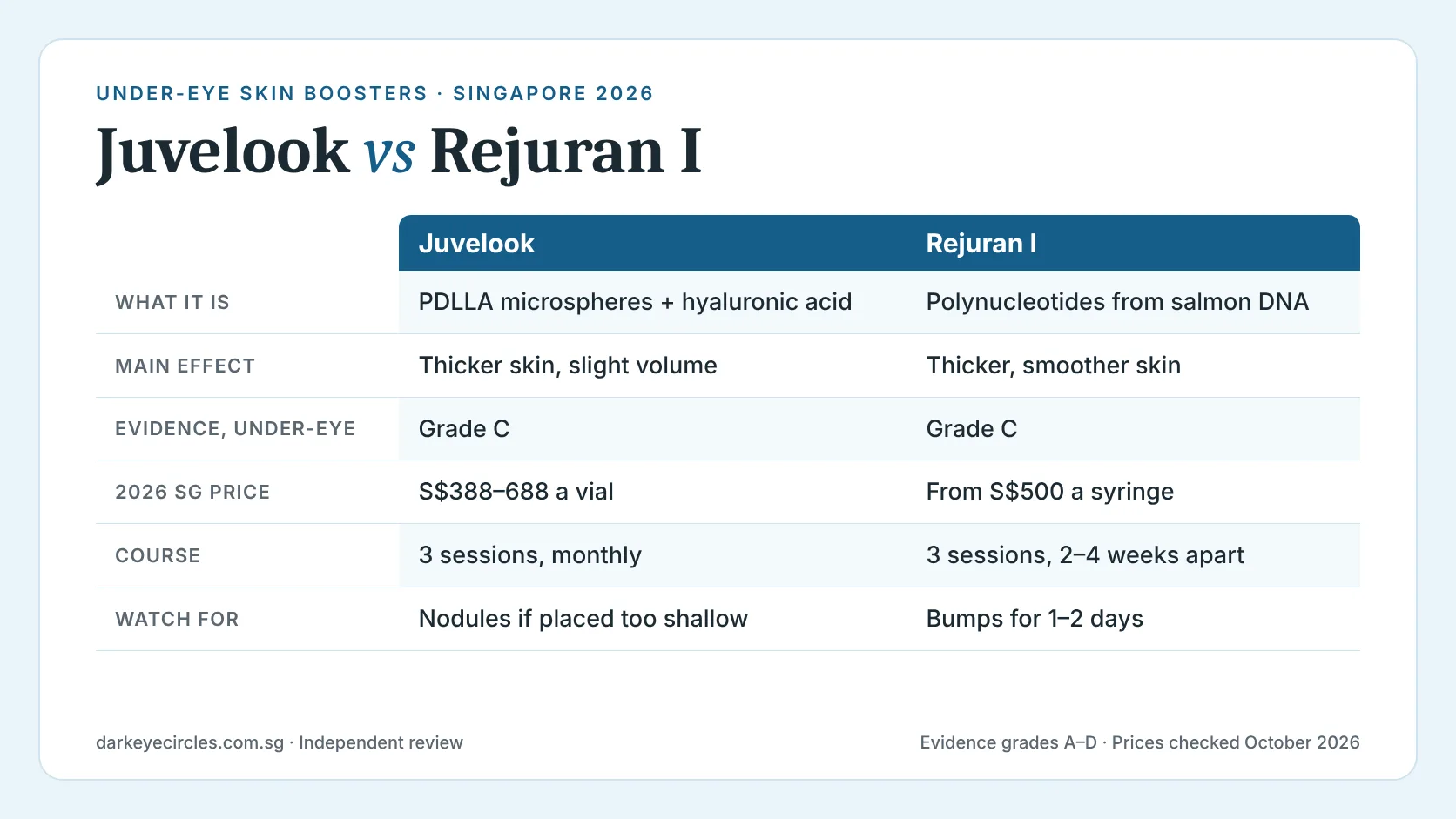
Juvelook vs Rejuran at a glance
The table compares the two products as used under the eyes in Singapore. Evidence grades follow the scale on the About page, and prices are drawn from published clinic price lists.
| Rejuran I | Juvelook | |
|---|---|---|
| What it is | Polynucleotide booster from purified salmon DNA fragments | PDLLA microspheres with non-cross-linked HA, supplied as a powder and reconstituted before injection |
| How it works | Supports the repair activity of fibroblasts, the cells that produce collagen, and binds water in the dermis | HA hydrates immediately, and the PDLLA particles stimulate new collagen over 2 to 3 months as they are absorbed |
| Main effect under the eye | Thicker, smoother, less crepey skin, with less visible blue veins | Thicker skin and slight volume over a mild hollow |
| Evidence grade, under-eye | C | C |
| 2026 Singapore price | From S$500 per syringe (S$388 to 900) | S$388 half vial, S$688 full vial (S$388 to 1,200 per session) |
| Usual course | 3 sessions, 2 to 4 weeks apart, then every 6 months | 3 sessions, 4 weeks apart, then every 6 months |
| Downtime | Injection bumps for 1 to 2 days | Swelling for 2 to 3 days |
| Longest published follow-up | 3 months | 6 months |
| Main risks | Bruising, temporary bumps | Bruising, swelling, nodules if placed too superficially, rare vascular blockage |
| Singapore registration (HSA) | Rejuran: listed for the face, naming crow’s feet and cheek | Listed to fill skin depressions and restore soft-tissue volume |
Neither product’s Singapore registration names the under-eye area, so use there rests on the injector’s clinical judgement rather than on a registered indication.
How Juvelook and Rejuran work under the eyes
- Rejuran I Polynucleotides are chains of DNA fragments purified from salmon. Injected as small droplets into the dermis, they are proposed to act as a scaffold for tissue repair and to stimulate fibroblasts, and they also bind water. Rejuran I is the eye-area formulation of the Rejuran range. Because it adds no meaningful volume, its effect is confined to the thickness, elasticity and fine crepey lines of the skin.
- Juvelook Each vial contains 42.5 mg of PDLLA microspheres and 7.5 mg of non-cross-linked HA and is reconstituted with saline before use. The HA provides immediate hydration. As the PDLLA particles are absorbed over the following months, they provoke a controlled inflammatory response in which fibroblasts deposit new collagen around them, thickening the skin and adding a little volume.
- Juvelook Volume (Lenisna) is a different product It contains 170 mg of PDLLA and 30 mg of HA, four times the PDLLA content of a Juvelook vial, and is designed to restore volume in areas such as the nasolabial folds. A quote for “Juvelook” should name the product being injected.
Juvelook vs Rejuran for dark circles and thin under-eye skin
The choice of product depends on the type of dark circle, as explained on the Dark eye circles guide.
- Vascular or thin-skin circles Blue-purple circles, in which veins show through thin skin, respond to both products, because a thicker dermis conceals more of the underlying vessels. Rejuran I is the lower-risk choice where the skin is thin and no hollow is present.
- Brown, pigmented circles Neither product removes pigment, because neither acts on melanin. Pigment responds to laser and lightening creams, which are compared on Dark eye circles treatment in Singapore.
- Crepey lower-lid skin Both products soften fine lines by thickening the dermis. Neither tightens a fold of loose skin, which requires radiofrequency or surgery (covered on Sagging skin under eyes treatment).
Juvelook vs Rejuran for under-eye hollows and tear troughs
For a mild hollow, Juvelook is the more suitable of the two, because its PDLLA adds slight volume whereas Rejuran I adds almost none. In a Singapore-led study of 15 women given three Juvelook sessions, tear-trough appearance improved after each session. Neither product, however, replaces hyaluronic acid tear-trough filler for a definite groove. Filler has Grade A evidence, including a randomised trial of 333 patients, and corrects the hollow in a single session. The full comparison is on Sunken eyes treatment in Singapore.
What the evidence says about Juvelook and Rejuran
- EvidenceEvidence for Rejuran I and polynucleotides under the eyes, Grade C. A prospective study of 42 patients without a control group reported improved lower-lid and crow’s-feet scores up to 3 months after two sessions. An open-label study of 61 patients treated for periorbital darkness reported a shift towards milder pigmentation after three injections. In one small randomised split-face trial (27 patients enrolled) comparing a PN product with a non-cross-linked HA product around the eyes, overall improvement was similar, although the PN side scored better on roughness and pore volume. These studies tested polynucleotide products in general rather than Rejuran I in every case. A 2026 review found no direct comparative trials against filler.
- EvidenceEvidence for Juvelook under the eyes, Grade C. The main study is an uncontrolled prospective cohort of 15 women given three sessions of about 0.4 ml per eye. Investigator and patient scores improved, as did lower-lid elasticity, hydration and radiance, although both authors have received speaker fees from the manufacturer. A small Korean case series reported tear-trough improvement maintained at 6 months. The only randomised trial of a Juvelook-family product compared Juvelook Volume with poly-L-lactic acid in the nasolabial folds, not under the eyes.
- Juvelook vs Rejuran head to head, Grade D No human study has compared the two products. The only direct comparison is a 12-week study in mice, and results in mouse skin do not predict the response of the human lower lid.
Juvelook vs Rejuran price in Singapore (2026)
| Product | Per session | Course of 3 | What the price covers |
|---|---|---|---|
| Rejuran I | From S$500 (S$388 to 900) | S$1,200 to 2,700 | Usually priced per 1 ml syringe, by some clinics per 2 ml |
| Juvelook | S$388 half vial, S$688 full vial (up to S$1,200) | S$1,200 to 2,100 at vial prices, up to S$3,600 where clinics charge S$1,200 a session | Priced per vial, per 2 ml syringe or per session |
Juvelook is quoted per vial at some clinics and per syringe or per session at others, so quotes are comparable only when they state the product, the volume and the number of sessions. Some clinics list Juvelook only under the generic name “PDLLA skin booster”.
Juvelook vs Rejuran side effects and nodule risk
- Rejuran I Small bumps form at the injection points for 1 to 2 days, and bruising occurs occasionally. No serious adverse events were reported in the randomised periocular trial.
- Juvelook Swelling lasts 2 to 3 days, and bruising occurs occasionally. The risk specific to Juvelook is nodules, firm lumps that can appear weeks after injection, usually where the particles have been placed too superficially in the thin lower-lid skin. Published cases include tear-trough nodules three weeks after Juvelook that resolved with radiofrequency treatment, and lower-eyelid granulomas after PDLLA injections that required two operations.
- Vascular blockage Any injected particle can block a blood vessel, and particles that enter a facial artery can be carried backwards into the arteries supplying the eye and brain. A Singapore case report describes vision loss and strokes after PDLLA was injected into the nasolabial folds and under the eyes. The complication is rare, but its risk is the reason under-eye injection should be performed by a doctor trained to recognise and treat it.
Can you combine Juvelook and Rejuran?
Some Singapore clinics sell packages that alternate the two products, or that place Rejuran I under the eyes and Juvelook on the cheeks. No study has tested the combination under the eyes (Grade D), so there is no evidence that it outperforms either product alone. A combined plan should specify the site of each product, the volume of each and the interval between sessions.
Which lasts longer, Juvelook or Rejuran?
Juvelook is designed to last longer, because its PDLLA particles are absorbed over months and continue to stimulate collagen throughout that period. Published follow-up, however, extends to 6 months at most for Juvelook and 3 months for polynucleotides. Clinic claims that Juvelook lasts up to 24 months are not supported by study results. Clinics usually advise a maintenance session every 6 months for either product.
Juvelook or Rejuran, which to choose for each under-eye problem
- Thin, crepey or bluish under-eye skin with no hollow Rejuran I is the first choice, as it carries the lower risk of lumps.
- Thin skin with a mild hollow Juvelook is the better option because it adds slight volume, although it carries a small risk of nodules.
- A definite tear-trough groove Hyaluronic acid filler corrects the groove, and either booster can be added to improve the quality of the overlying skin.
- Brown pigment Laser or lightening creams are required, as neither booster acts on pigment.
Other under-eye boosters are compared in Profhilo vs Rejuran.
Frequently asked questions about Juvelook and Rejuran
Is Juvelook or Rejuran better for dark circles?
For blue, thin-skin dark circles, both products can help, because both thicken the skin over the vessels. Rejuran I carries the lower risk of lumps. For a circle caused by a hollow, Juvelook adds slight volume, whereas hyaluronic acid filler adds more. Neither treats brown pigment.
Does Juvelook cause lumps under the eyes?
Juvelook can cause nodules, usually when the product is placed too superficially in the thin lower-lid skin. Most published cases resolved with treatment, although some required surgery.
How many sessions of Juvelook or Rejuran are needed?
Three sessions is the usual course for both, at intervals of 2 to 4 weeks for Rejuran I and 4 weeks for Juvelook, followed by maintenance about every 6 months.
Can Juvelook replace tear trough filler?
Juvelook improves a mild hollow and the skin over it, but it does not correct a deep tear trough. Hyaluronic acid filler has much stronger evidence for a deep tear trough.
Is Rejuran made from salmon DNA?
Rejuran contains polynucleotides, which are DNA fragments purified from salmon. A fish allergy should be disclosed to the treating doctor before treatment.
General information, not medical advice. A registered medical practitioner should be consulted before any treatment. Dark Eye Circles Singapore does not sell treatments.
Sources and price references (checked 8 October 2026)
- Young SM, Lau EKH. Hybrid Biostimulator and Hyaluronic Acid Injectable for Tear Trough Rejuvenation. Aesthetic Plast Surg. 2026;50(13):5337–5343. doi:10.1007/s00266-026-05817-z (PMID 42098500) — Prospective cohort, 15 women, Juvelook (PDLLA-HA 50 mg), 3 sessions; no control group; authors report VAIM speaker honoraria https://doi.org/10.1007/s00266-026-05817-z
- Wan J, et al. Evaluating Poly-D,L-Lactic Acid for Lower Eyelid Rejuvenation: Efficacy and Safety. J Cosmet Dermatol. 2025;24(3):e70058. doi:10.1111/jocd.70058 (PMID 40017393) — Small case series, Juvelook for tear trough, 6-month follow-up https://doi.org/10.1111/jocd.70058
- Park JY, et al. A Split Face Study Comparing the Effect of a PDLLA Based Product and PLLA on the Nasolabial Fold (NLF). Skin Res Technol. 2026;32(1):e70324. doi:10.1111/srt.70324 (PMID 41532837) — Randomised split-face, 33 subjects, Juvelook Volume vs PLLA, nasolabial folds, non-inferior at 24 weeks https://doi.org/10.1111/srt.70324
- Lee KWA, et al. Poly-d,l-lactic Acid (PDLLA) Application in Dermatology: A Literature Review. Polymers (Basel). 2024;16(18):2583. doi:10.3390/polym16182583 (PMID 39339047) — Review of PDLLA composition, mechanism and complications https://doi.org/10.3390/polym16182583
- Seo SB, Wan J, Yi KH. Energy-Based Device Management of Nodular Reaction Following Poly-D, L-Lactic Acid Injection for Tear Trough Rejuvenation. J Cosmet Dermatol. 2025;24(1):e16575. doi:10.1111/jocd.16575 (PMID 39283001) — Case report, nodules 3 weeks after Juvelook in the tear trough https://doi.org/10.1111/jocd.16575
- Garlaschi A, et al. Complex Surgical Management of PDLLA-Induced Lower Eyelid Granulomas. J Craniofac Surg. 2026. doi:10.1097/SCS.0000000000012811 (PMID 42043184) — Case report, lower-eyelid granulomas after PDLLA requiring surgery https://doi.org/10.1097/SCS.0000000000012811
- Tan YJ, Sugianto N, Li Y. Multifocal strokes and vision loss from PDLLA filler injections. J Stroke Cerebrovasc Dis. 2024;33(3):107556. doi:10.1016/j.jstrokecerebrovasdis.2024.107556 (PMID 38184971) — Singapore case report, PDLLA to nasolabial folds and infraorbital area https://doi.org/10.1016/j.jstrokecerebrovasdis.2024.107556
- Giang NN, et al. Evaluation of Bio-Stimulation Effects of Various Dermal Fillers: Hyaluronic Acid-Based Polynucleotides and Micro-particles. Aesthetic Plast Surg. 2025;49(19):5611–5622. doi:10.1007/s00266-025-05195-y (PMID 40897965) — Mouse study, 12 weeks, HA-PDLLA and salmon PN among other fillers https://doi.org/10.1007/s00266-025-05195-y
- Lee YJ, et al. Comparison of the effects of polynucleotide and hyaluronic acid fillers on periocular rejuvenation: a randomized, double-blind, split-face trial. J Dermatolog Treat. 2022;33(1):254–260. doi:10.1080/09546634.2020.1748857 (PMID 32248707) — Randomised split-face, 27 enrolled, PN vs non-cross-linked HA, 3 sessions 2 weeks apart https://doi.org/10.1080/09546634.2020.1748857
- Ziade G, et al. Prospective Observational Study of Polynucleotide Injections for Periorbital Rhytides. J Cosmet Dermatol. 2026;25(2):e70736. doi:10.1111/jocd.70736 (PMID 41689167) — Prospective observational, 42 patients, no control https://doi.org/10.1111/jocd.70736
- Amado R, et al. A Real-World Study of Polynucleotides HPT for Treating Periorbital Hyperpigmentation. Clin Cosmet Investig Dermatol. 2026;19:1–15. doi:10.2147/CCID.S605046 (PMID 42164086) — Open-label cohort, 61 subjects, 3 injections; no control https://doi.org/10.2147/CCID.S605046
- Khan RS, Hafeez K. Hyaluronic Acid Fillers Versus Polynucleotides for Under-Eye Rejuvenation. J Clin Med. 2026;15(13):4971. doi:10.3390/jcm15134971 (PMID 42452433) — Literature review; no direct comparative RCTs https://doi.org/10.3390/jcm15134971
- Biesman BS, et al. A Multicenter, Randomized, Evaluator-Blinded Study to Examine the Safety and Effectiveness of Hyaluronic Acid Filler in the Correction of Infraorbital Hollows. Aesthet Surg J. 2024;44(9):1001–1013. doi:10.1093/asj/sjae073 (PMID 38573527) — RCT, 333 patients, tear-trough filler https://doi.org/10.1093/asj/sjae073
- Health Sciences Authority, Singapore Medical Device Register: Rejuran, DE0500702; Vaim Juvelook, DE0507634; Vaim Lenisna 200, DE0507633 (data.gov.sg download, April 2026 listing) https://data.gov.sg/datasets/d_e697cc1e4caec596c0e9318fdd9420a3/view
- Rejuran I price: Sozo Aesthetic Clinic — Rejuran i from S$500 per session (checked 2026-10-05) https://sozoclinic.sg/dark-eye-circles/treatment/
- Rejuran I price: Halley Medical Aesthetics — S$490 (PDRN Skin Booster for Eye, 1 ml syringe) (checked 2026-10-05) https://www.halley.com.sg/price-list/
- Rejuran I price: SL Aesthetic Clinic — from S$480 (Korean PN Eyes) (checked 2026-10-05) https://slclinic.com.sg/price-list/
- Rejuran I price: Bay Aesthetics Clinic — S$388 first syringe; S$545 per syringe in a 3-syringe package (checked 2026-10-05) https://www.bayclinic.sg/treatment/rejuran-healer-skin-boosters/
- Rejuran I price: BA Clinic — S$650 per 2 ml (polynucleotide) (checked 2026-10-05) https://baclinic.sg/treatments/skinbooster/
- Juvelook price: Bay Aesthetics Clinic — S$388 nett (JuveLook 3 ml); S$988 nett (full vial plus 2 ml HA booster) (checked 2026-10-08) https://www.bayclinic.sg/juvelook-and-lenisna-juvelook-volume-price-in-singapore/
- Juvelook price: Nueva Clinic — from S$688 per session (checked 2026-10-05) https://nuevaclinic.sg/treatment/juvelook/
- Juvelook price: V Medical Aesthetics — PDLLA Skin Booster S$1,200 nett (checked 2026-10-08) https://www.vaestheticsclinic.com.sg/juvelook/
- Juvelook price: Halley Medical Aesthetics — S$980 (PDLLA Skin Booster 2 ml) (checked 2026-10-05) https://www.halley.com.sg/price-list/
- Juvelook price: BA Clinic — S$950 per 2 ml (PDLLA skin booster) (checked 2026-10-05) https://baclinic.sg/treatments/skinbooster/
Dark Eye Circles in Singapore: this series
Treatment reviews for dark eye circles:
- Allergic Shiners Treatment Singapore
- Best Eye Cream for Dark Circles in Singapore
- Collagen Skin Booster Under Eye Singapore
- Juvelook Under Eye Singapore
- Pico Laser for Dark Circles Singapore
- Rejuran Under Eye Singapore
- Tear Trough Filler Singapore
Comparisons for dark eye circles: